

Semaglutide peptide has fundamentally shifted metabolic and endocrinology research. This synthetic analog of human glucagon-like peptide-1 (GLP-1) demonstrates exceptional biological stability. Researchers utilize this compound to investigate cellular signaling, insulin secretion pathways, and metabolic regulation.
Understanding the structural modifications of this peptide is critical for laboratory investigations. Unlike endogenous hormones, the semaglutide molecule features specific amino acid substitutions. These precise engineering choices prevent rapid enzymatic degradation during long-term studies.
This article explores the structural properties and synthesis mechanisms of this prominent molecule. We will detail its binding behavior at the receptor level. We will also examine best practices for handling research-grade materials in controlled laboratory environments.
What Is the Molecular Structure of Semaglutide Peptide?
The efficacy of semaglutide peptide stems from its highly engineered molecular architecture. The base structure consists of a 31-amino-acid chain. It shares a 94% sequence homology with native human GLP-1.
Two primary modifications distinguish this peptide from its natural counterpart. First, the amino acid alanine at position 8 is replaced with alpha-aminoisobutyric acid (Aib). This critical substitution provides steric hindrance against dipeptidyl peptidase-4 (DPP-4) degradation.
Second, the molecule features a targeted modification at position 26. A lysine residue is attached to a C-18 fatty di-acid chain via a hydrophilic spacer. This structural addition enables strong non-covalent binding to serum albumin.
The theoretical average molecular weight of semaglutide is 4113.58 g/mol . In experimental settings, this mass directly influences dissolution rates and receptor binding kinetics. These parameters dictate how the molecule interacts with G-protein-coupled receptors.
| Feature | Native Human GLP-1 (7-37) | Semaglutide Peptide |
| Position 8 | Alanine | Alpha-aminoisobutyric acid (Aib) |
| Position 34 | Lysine | Arginine |
| Position 26 | Unmodified Lysine | Lysine bound to C-18 fatty di-acid |
| Enzymatic Stability | Rapid degradation (minutes) | High resistance against DPP-4 |
| Binding Mechanism | Free circulation | Albumin-bound transport |
The Role of the GLP-1 Receptor in Cellular Mechanisms
The semaglutide peptide acts as an agonist for the glucagon-like peptide-1 receptor. This specific receptor belongs to the Class B G-protein-coupled receptor family. It is predominantly expressed on the surface of pancreatic beta cells.
Upon binding to the extracellular domain, the peptide triggers a conformational change. This physical shift activates the internal adenylate cyclase enzyme pathway. Subsequently, intracellular cyclic AMP (cAMP) levels rise rapidly within the cell.
Elevated cAMP concentrations activate protein kinase A and Epac2 signaling molecules. These secondary messengers stimulate the release of insulin from internal cellular vesicles. Researchers monitor this exact pathway when studying metabolic responses to synthetic peptides.
Solid-Phase Peptide Synthesis (SPPS) vs. Recombinant Methods
The production of complex biochemicals relies on two distinct manufacturing philosophies. Industrial pharmaceutical production often utilizes recombinant DNA expression in yeast cells. This biological method is highly efficient for generating the base peptide backbone.
Conversely, chemical solid-phase peptide synthesis (SPPS) is critical for customized laboratory production. This technique builds the semaglutide peptide amino acid by amino acid. SPPS does not require biological organisms, offering precise control over non-canonical modifications.
Attaching the C-18 fatty di-acid chain requires specialized orthogonal protection strategies. Chemists must selectively deprotect the lysine residue at position 26. This targeted deprotection ensures the lipid chain attaches only at the designated location.
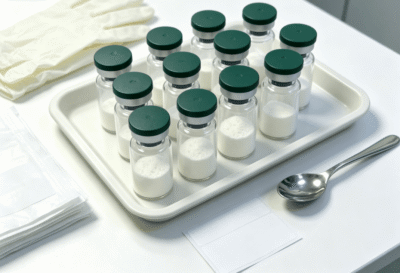
Workflow for Identifying Deletion Impurities
Stringent analytical testing is mandatory to ensure peptide integrity for laboratory use. Incomplete SPPS reactions can generate truncated sequences or deletion impurities. These structurally flawed molecules can unpredictably alter binding affinities in research models.
Laboratories execute a precise analytical workflow to validate material purity:
Dissolve the lyophilized powder in a standardized mobile phase solution.
Inject the sample into a high-performance liquid chromatography (HPLC) system.
Separate the target semaglutide peptide from smaller synthesis byproducts.
Analyze the isolated fractions using tandem mass spectrometry (MS/MS).
Compare the experimental molecular weight against the theoretical 4113.58 g/mol standard.
This rigorous procedure identifies missing residues, such as a deleted Aib substitution. Ensuring high molecular fidelity is essential before conducting sensitive cellular assays.
Key Metabolic Research Applications for Semaglutide
In the laboratory, researchers apply semaglutide to investigate metabolic dysfunction mechanisms. The peptide binds to the GLP-1 receptor extracellular domain. This interaction triggers intracellular pathways that regulate glucose homeostasis.
One primary application involves studying pancreatic beta-cell function. The semaglutide peptide stimulates glucose-dependent insulin secretion in cellular models. Scientists track these signaling cascades to understand receptor down-regulation and cellular fatigue.
Neurological and behavioral research represents another significant application area. GLP-1 receptors populate the hypothalamus, which acts as the neurological appetite control center. In vivo preclinical models use this peptide to map neurochemical pathways governing satiety.
Scientists also evaluate the compound’s tissue repair and anti-inflammatory properties. Recent studies monitor how targeted receptor activation influences cardiovascular tissue stability. These interdisciplinary applications require highly stable, reproducible biological reagents.
How to Evaluate Research-Grade Lyophilized Semaglutide
Selecting appropriate laboratory materials directly impacts the validity of experimental outcomes. Research-grade semaglutide peptide is typically supplied as a lyophilized powder. This dehydration process maximizes shelf life and prevents premature peptide degradation.
When sourcing biochemicals, procurement managers and lead scientists must verify analytical documentation. A legitimate Certificate of Analysis (COA) should confirm a molecular purity exceeding 99%. It should also detail the exact molecular weight and the absence of critical deletion impurities.
For institutions looking to scale their laboratory operations, sourcing from a dedicated peptide product category streamlines the procurement workflow. Reliable B2B suppliers utilize advanced synthesis and purification systems. This manufacturing capability ensures that researchers receive standardized compounds suitable for the most stringent analytical testing.
Advanced Storage and Reconstitution Parameters
The physical stability of semaglutide peptide depends heavily on proper storage environments. Environmental factors like humidity, temperature, and light can accelerate chemical degradation. Lyophilized powders offer superior longevity compared to pre-mixed aqueous solutions.
During reconstitution, scientists must prevent aggressive mechanical agitation. Shaking the vial vigorously can cause the peptide chains to shear and aggregate. Instead, researchers gently swirl the diluent to dissolve the freeze-dried solid.
Buffered saline solutions are often preferred for maintaining the optimal pH level. Maintaining a stable pH prevents the precipitation of the hydrophobic fatty acid chain. Once prepared, the active solution must be kept strictly away from direct ultraviolet light.
FAQ
What receptor does semaglutide target in research models?
Semaglutide selectively targets the GLP-1 receptor. This is a Class B G-protein-coupled receptor found predominantly in pancreatic and neural tissues.
Why is Aib substituted at position 8 in the peptide chain?
The substitution of alpha-aminoisobutyric acid prevents the DPP-4 enzyme from cleaving the peptide chain. This modification dramatically increases the molecule’s structural stability in experimental assays.
How does the C-18 fatty acid chain affect the molecule?
The attached fatty di-acid chain facilitates strong non-covalent binding to albumin proteins. In biological models, this mechanism significantly prolongs the active circulation time.
What is the standard storage protocol for this peptide?
Lyophilized semaglutide peptide should be stored at sub-zero temperatures, typically -20°C. Upon reconstitution, it must be refrigerated and utilized within the timeframe specified by the manufacturer.
How is research-grade purity verified?
Purity is validated through high-performance liquid chromatography (HPLC). Mass spectrometry is also utilized to confirm the exact molecular weight and detect any trace deletion impurities.
Reference Sources
FDA Center for Drug Evaluation and Research. Semaglutide Clinical Pharmacology and Biopharmaceutics Review.
Zhang, Y., et al. Cryo-EM structure of the activated GLP-1 receptor in complex with a G protein. Nature.
Lau, J., et al. Discovery of the Once-Weekly Glucagon-Like Peptide-1 (GLP-1) Analogue Semaglutide. Journal of Medicinal Chemistry.
ASTM E2524-22 Standard Test Method for Analysis of Peptides and Proteins.

-1-800x800.png)
-800x800.png)
-800x800.png)
-800x800.png)
-800x800.png)
-800x800.png)
-800x800.png)
-800x800.png)
-800x800.png)
-800x800.png)
-800x800.png)
-800x800.png)
-800x800.png)
-800x800.png)
-800x800.png)